Take Off the Mask: A Key to Living Authentically

#boise #idaho #spirit #mindfulness

Healthy Living – The Huffington Post
Take Off the Mask: A Key to Living Authentically
We’re coming up on a very strange, yet neighborly, holiday. Halloween, the night when we invite our neighbor’s children to venture up to our front door and accept candy from us. What’s even stranger is that some of us like to make their trek as frightening as possible. Some sweet little Cinderella and her 2-year-old baby ninja brother ring the doorbell and we jump out, wearing a creepy Richard Nixon mask. Yes, nothing says, “Won’t you be my neighbor?” more than Halloween, does it?

I’ll confess that I don’t know much about my neighbors. I keep intending to get to know them better. In my mind’s eye, I have this idyllic picture of me taking a fresh-baked pie over and having quality coffee time with them. But that would mean, first of all, me learning to bake a pie. Secondly, it would take time out of my already packed schedule. And, let’s face it, it would take courage to knock on their door. After all, who knows what kind of people live behind those walls?

In truth, most of us know very little about our neighbors. And what we do know, or supposedly know, is more than likely gossip based on a bunch of big, fat lies.

Well, talking about neighbors and about lying leads me to some ancient instruction about how to live authentically. It’s found, believe it or not, in the ninth of the Ten Commandments, which says:

“You shall not bear false witness against your neighbor.”

“False witness.” That sounds like something from the days of powdered wigs, doesn’t it? Like “Hear ye! Hear ye! Thou hast been a false witness! Off with his head!” But a simple definition of false witness would be “one who presents misleading or mistaken information.”

Another word in this edict that we’ve heard used quite a bit lately is the word bear. “To bear,” means, “to harbor, or to carry, like to carry a heavy burden.” So if I may, in my Pollyannaish way, reword this decree into a more positive declaration, it would read like this:

“Don’t give safe harbor to false information and mistaken ideas about your neighbor.”

I was always taught that the ninth commandment said, “Don’t lie.” But, looking deeper we find that it’s not so much about telling lies as it is about believing them.

Why would this be important?

First of all, believing false information about your neighbor keeps you in a place of fear. I call it Foe Fear, or should I spell it Faux Fear? It’s the fear that what you think is good, right, and acceptable might not be the same as what your neighbor thinks. So, you piece all sorts of mistaken ideas together, convincing yourself that whoever lives on the other side of that backyard fence is up to something and you just know that it can’t be good. So the walls go up.

By believing false or misleading information about your neighbor, you can’t possibly see them honestly and clearly. In a way, you’ve put a mask on them.

But digging even deeper we find a much more important key to authentic living. You see, the truth is that your neighbor is who you are — an expression of Pure Truth. So when you rally your forces to be on the lookout for dishonesty, deceit, and deception in others, you keep your mind in a stressful condition contrary to who you really are. You might as well be wearing a mask.

At the core of this cosmic credo is The Principle of Authenticity. It challenges us to take back the energy we’ve been expending on fears and false beliefs and to connect with the truth about Life, ourselves, and about others.

So, take off the mask. Erase all doubt about who you really are and what you’re here to do. Allow yourself to clearly see yourself and your neighbor and it will, in the words of the wise, set you free — free to live life the way it’s meant to be lived — peacefully, truthfully, authentically and successfully.

Investing in Mental Health
Today, the issue of mental illness affects an estimated 350 million people around the world, according to the World Health Organization (WHO). Depression will be the second highest cause of disease burden in middle-income countries and the third highest in low-income countries by 2030 (1). Statistics reveal that 26 percent of the population in the United States has some kind of mental illness (2), and 25 percent of Europe is suffering from depression or anxiety (3).

Unfortunately, many people don’t even acknowledge that they are depressed, and nearly 50 percent of major depression goes untreated (4). Neither at school nor at home are we taught how to our handle negative emotions. We teach dental hygiene but forget to teach mental hygiene. Stress does not go away by just talking or advising. We need to learn some techniques and tools to get rid of stress and calm the mind.

Why does an individual get depressed? Some depression may be because one is hanging onto the past or is over-ambitious and anxious about the future. Life, however, is a continuous process of teaching one how to “let go.” Change is the only constant. When one does not acknowledge the phenomenon of change, and becomes stuck to a position, then one can experiences frustration, depression, and so on. Often, you are not aware that you are connected with the whole universe, and you think you are just some small person wanting small little things. How do we get out of this small mind? We must look to enquire into the core of our existence. What is life? Who am I? What do I want? This spirit of self-inquiry can awaken something inside you. Negative emotions can make you sink into depression, and wisdom of the Self can take you out of depression. This is where meditation and breathing techniques can play an important role. They are the tools that help you calm your mind, and make you feel happy from within. Many illnesses can be helped through meditation and breathing techniques. In fact, I would say that meditation is food for the soul.

Meditation has many benefits. When our mind is calm, we are able to make better decisions, thus creating a more harmonious and positive atmosphere around us. There is a significant body of research on how meditation helps improve conditions such as
hypertension, diabetes, heart problems, sleep disorders, and nervous system disorders, among others (5).

Apart from benefiting physical health, meditation improves concentration and helps one be in the present moment. If you observe, the mind vacillates between the past and the future. We are either angry about the past or anxious about the future. Meditation helps bring the mind to the present. When the mind is calm, we are able to perceive things better. When the mind is disturbed, our perception is also disturbed. In daily life, one comes across situations that can be challenging and require us to take effective decisions. These situations often influence to the state of our mind — so much so that we cannot take effective decisions. Neither events in life nor the states of our mind happen with our permission. In fact, the events and states of mind often occur in direct defiance to our wishes.

Meditation can bring about a balance between the different states of the mind. One can learn to switch from the tough aspect to the gentler aspect within you. One can be firm when appropriate and at the same time let go when needed. This ability is present within everyone, and meditation enables you to switch between these states effortlessly. With a few minutes of daily meditation and pranayama (breathing techniques), our thoughts become powerful, and our tasks are accomplished more effectively. Through meditation and breathing techniques, we can cleanse our mind of negative emotions and effectively address mental illness and depression.

Meditation can bring about a big transformation in society.

Footnotes:

(1) See http://www.who.int/mediacentre/news/releases/2010/mental_disabilities_20100916/en/index.html

(2) See http://www.thekimfoundation.org/html/about_mental_ill/statistics.html

(3) See http://www.euro.who.int/en/what-we-do/health-topics/noncommunicable-diseases/mental-health/news/news/2012/10/depression-in-europe/depression-in-europe-facts-and-figures

(4) Ibid

(5) http://www.mayoclinic.com/health/meditation/HQ01070

For more information on the author visit:
www.srisriravishankar.org
For more on breathing and meditation programs, visit www.artofliving.org
To register for a program with Sri Sri at the International Center for Well Being and Peace in US, visit
http://www.artofliving.org/intl-meditation-center-usa
Follow Sri Sri @SriSriSpeaks

Using Drones in the Fight Against Apple Scab

#boise #idaho #spirit #mindfulness

Green – The Huffington Post
Using Drones in the Fight Against Apple Scab
apple

Article and photography by Rachel Rohr

For apple growers in the eastern United States, the biggest problem — the most relentless, pervasive, unavoidable issue, which can ruin a whole crop if not managed aggressively — is apple scab. Researchers at the University of New Hampshire are working on a new tool to combat the apple scourge: A drone.

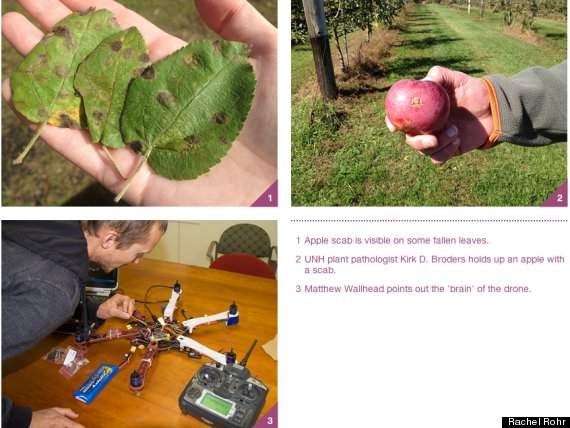
The fungal infection causes dark scabby lesions on the leaves and skin of the apple, which leaves the flavor unaffected, but does effectively make it unsalable.

“It’s a huge issue,” says Peter Wagner, owner of Applecrest Farm Orchards, a 110-acre orchard in southeast New Hampshire. “Thirty years ago, you were allowed to have a scab on your apple that was probably 10 millimeters, or half the size of a dime, without a problem at all. Now you can’t put any of that in the apple pack, so it renders the apple unmarketable.”

Apple scab is less of an issue in drier regions, such as Washington state. But in places like New York, New Hampshire, Vermont or Massachusetts, apple scab is the number one pathogen and apple farmers’ primary concern.

In recent decades, researchers have made strides in understanding the fungus’s life cycle, so farmers are spraying less than they used to, with better results. Some farmers even use predictive models, such as the Dutch program RIMpro to forecast the best spraying times. But apple scab is still a persistent battle, and it’s especially difficult – if not nearly impossible – for organic farmers to grow a scab-free crop.

So researchers at the University of New Hampshire are working on a new tool for fighting apple scab: Drones.

modfarm
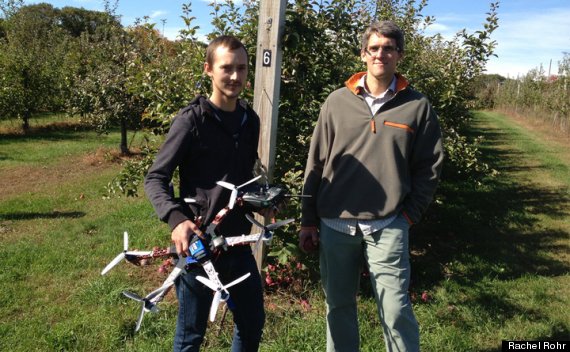
Researchers Matthew Wallhead and Kirk D. Broders stand with the prototype apple scab drone.

“When you think about apple production now, a grower needs to walk through his orchard every day to make sure he sees any new insect pests or any new disease pests that come into an orchard,” says plant pathologist Kirk D. Broders, an assistant professor at UNH. “But when you’re talking about a 10, 20, 100-acre orchard, your ability to do that on a daily basis is almost impossible.”

But it is possible with a small unmanned aerial vehicle (UAV), or drone, carrying an infrared camera that takes multispectral images of the orchard. A computer program crunches the wavelengths in each pixel, making it possible to hone in on colors and temperatures – and locate apple scab.

df

“If you had a UAV that had the capacity to go up once a day, take a digital image or multiple digital images — both in infrared and then in normal spectrum — you could actually monitor your orchard using a $2,000 UAV,” says Broders.

Graduate student Matthew Wallhead is leading the project at UNH, and built the first such system this summer for about $2,400. It includes a low-cost surveillance drone from a Massachusetts startup called Rotary Robotics – though Wallhead prefers the term UAV as “the term ‘drone’ has traditionally implied a weaponized system,” he says — and two point-and-shoot digital cameras. Wallhead removed the infrared filters from the cameras using an online tutorial.

“We converted a $100 camera into the equivalent of what a $4,000 camera will give you, so that’s exciting,” says Wallhead. “This season has been largely focused on tuning it and learning to fly the aircraft effectively.”

Broders says the ultimate goal is to develop an orchard-monitoring UAV system that could be sold to growers for under $2,500, though he estimates they’re five years away from an actual product.

It’s not the first time that multispectral imaging has been used in agriculture. Researchers have analyzed plants using lab equipment, and large farming operations can hire airplanes to fly over and take multispectral images of large swaths of corn or soybeans to monitor crop health.

“What we are trying to do is develop a system that allows us to do things in-between – so not at the single-plant lab scale, and not at the airplane several-fields-at-a-time scale,” Broders said. “We’re trying to develop a low-cost system that could actually be used by either individual researchers or individual growers.”

At Applecrest Farm, Peter Wagner calls the prospect of an affordable infrared imaging system that could be used daily, “pretty awesome.”

“I think that’s a great endeavor — no question — particularly the fact that most scab that we don’t eradicate usually occurs at the top of the tree,” Wagner said. “In the old days with big trees, you could climb up and look around – which is time consuming – but now with the new plantings, the trees are younger, smaller, and it’s harder to climb because the limbs aren’t as strong.”

Wallhead and Broders envision apple growers using the drone-camera system in conjunction with the predictive models for apple scab — the real-time data that tell farmers when to spray.

f
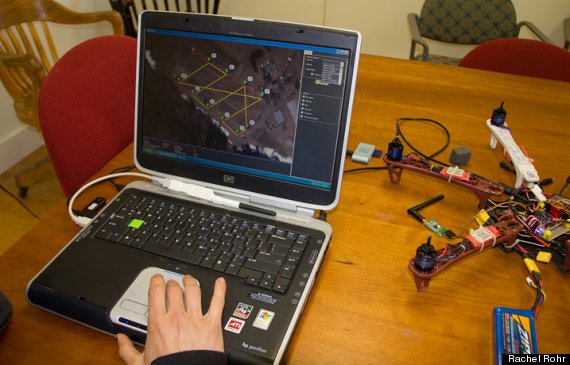
Matthew Wallhead charts out a hypothetical autopilot course for the drone.

“The UAV is really only one tool we’re using to manage apple scab, because apple scab is so difficult to control,” Broders said. “We’re using our predictive model to improve application of organically-certified compounds. We’re using the UAV for early detection. And then whenever possible, we’re utilizing resistant varieties to also help us reduce fungicide inputs and provide better control.”

One scab-resistant variety growing in the experimental research orchard at UNH’s Woodman Farm is Crimson Crisp, the product of collaboration among Purdue University, Rutgers and University of Illinois.

While apple scab is the main concern in the eastern U.S., the multispectral data can also be used to detect other problems – from insect damage to nitrogen deficiency. Pinpointed applications of fertilizer, pesticides and fungicides mean growers are using less, which is better for the environment and consumers — as well as the farmer’s bottom line.

The drones could even be used to monitor forest health, scanning for disease or invasive beetles.

“I think it has applications even beyond agriculture,” Broders said. “And I think there are a number of people that are just now beginning to understand what these unmanned aerial vehicles are capable of doing.”

This post was originally published on Modern Farmer.

GPS for the Soul – The Huffington Post
Living ‘In the Zone’
Some of my athlete friends have described to me what it’s like for them when they’re “in the zone.” They say it’s those times when they just know they’re going to make a basketball shot, or they know their bat is going to connect perfectly with the pitch that’s coming toward them. It’s those rare times in their sports career when they know they can run or swim faster and more effortlessly than ever before.

I think you don’t have to be an athlete to get “in the zone.” Students know it when something they have been struggling to learn all at once comes clear and the answers flood in. I had that experience when I was a little kid, flummoxed by mathematics. Those numbers were meaningless until that moment of understanding when the whole realm opened up like a sunrise at daybreak and math suddenly was revealed to me. I’ve lived more than a few years since, but I can still remember that experience of freedom and expansion… and joy.

So when was the last time you felt yourself “in the zone”? When did you last experience the sure-fire possibilities of the moment — those times when you reached into the hopes, dreams, and even the innocence you had as a child — into your true self? I have been thinking about that state of being, the one when I am at peace with myself, when everything is in order and success can’t be denied.

Could these be moments of the Soul? I’ve heard athletes say that — that their moment “in the zone” was a moment of Soul Awareness. I’ve been there and I bet you have too! I can also remember times when I have been so far out of the zone that I might as well have been in a different universe. At those times, I had to work to recapture that inner experience of connectedness, ease, and flawless timing.

It may sound strange, but I have found that loving appears to be a key. Loving — that experience that seems to be getting more and more scarce these days as people compete for fame, fortune, and connection with others. I’ve come to see love as the greatest single hallmark of the Soul — that spark of the Divine within each of us.

So here’s how I practice getting myself “in the zone”: I keep choosing love, no matter what. What am I talking about when I use the word “love”? One thing I could say about it is that in the face of annoyance or pain or embarrassment, “love” comes in when I choose to see what’s happening in a positive light, even if it would be hard at that moment to be positive! I work on choosing the positive qualities of joy, peace and compassion in myself or others. And once in a while, I find myself “in the zone.” When you see me, you see someone workin’ on it!

If you’re interested you can access A MOMENT OF PEACE: THE HEARTBEAT OF GOD here.

And this is the way to source my book WHEN ARE YOU COMING HOME?

For more by John-Roger, click here.

For more on emotional wellness, click here.

5 Fall Renovations

#boise #idaho #spirit #mindfulness

Green – The Huffington Post
5 Fall Renovations
Springtime is best known as the time we sweep out the winter dust to prepare for the incoming summer breeze. I find fall to be a great time to begin a few renovations to prepare for the winter — the air is crisp and clean, and the temperatures are still manageable. Here are a few green renovations to get your home ready for the upcoming winter holidays, as well as next year:

1 – You Can Never Have Enough Candles

The quickest and easiest renovation you can make to your home entering the colder months is installing candleholders. These can be wall-mounted in hallways, on tables and desks in rooms, or on shelves and counters in the bathroom and kitchen. Even your porch and patio should be equipped with a few candles.

In colder states, access to candles becomes imperative in the event of a winter storm, blackout, or other such events, providing light, heat, and a cooking source in the event of an emergency. People living in areas with warmer winters (California, Arizona, Florida, etc), candles can still be used to conserve electricity or infuse a scent into specific rooms of the house, regardless of what power plan you’re on.

2 – Build a Shed or Workshop

Fall is a great time to throw on a jean shirt or flannel and build something. Lumber and nails aren’t as expensive as you’d think, and there are a lot of great instructional videos online. Within a couple of weekends, you can get a basic structure up that can be turned into a storage shed or workshop in order to free up some much needed space as the cold sets in and we need our personal spaces to be soothing.

3 – Switch to Artificial Turf

Summer is traditionally known for landscaping weather, but this is only because live plants need to be firmly rooted before the harsh winter cold arrives. If you’ve been considering switching to artificial turf, however, fall can be a slow season in that industry, so it’s a great time to find a deal on synthetic grass.

Even though synthetic grass is known to be environmentally friendly, I used to be against the stuff back in the days when it felt like plastic carpet, but the synthetic grass we have out back looks and feels real, which helps perk up my mood during the grayer months of the year.

4 – Rearrange the Furniture

Nothing makes a house feel brand new again like a quick cleaning and furniture rearrangement. If you’ve been meaning to get unnecessary items stored away to open up space in your house, now is the time to do it. Family and friends may soon be coming to visit, and you’re going to need to think about space in all common areas (including the kitchen, dining room, and bathrooms). Rearranging the furniture now gives you time to live in it a little before adding more people to the mix, and getting your house in order may be exactly what you need to combat holiday stress.

5 – Grow an Indoor Garden

Just because the sun is going down earlier doesn’t mean you can’t still grow a garden. Technological advances have created hydroponic and aeroponic indoor garden setups that make growing any type of plant possible year-round. Installing such fixtures in walls will allow easy flower growth, whereas you can fill counters and tables with living tomatoes, spices, and assorted foods. If you hurry, you can grow a living Christmas centerpiece in time.

Brian Penny is a former business analyst at Bank of America turned whistleblower, consultant, and freelance writer.

Superstorm Sandy: Then And Now (EXCLUSIVE PHOTOS) – Weather.com

#boise #idaho #spirit #mindfulness

Green – The Huffington Post
Superstorm Sandy: Then And Now (EXCLUSIVE PHOTOS) – Weather.com
Superstorm Sandy ravaged parts of the Northeast coast last year, leaving millions without power and wreaking havoc throughout neighborhoods.

Healthy Living – The Huffington Post
Tricks To Combat Bloating, From Joy Bauer (VIDEO)
What foods make you bloat? Salt is the number one enemy when it comes to bloating, says health and nutrition expert Joy Bauer. Avoid foods that are high in sodium. Eating an excessive amount of carbohydrates can also lead to bloating, because carbs make your body retain water. The less salt and carbohydrates that you take in, the lighter you’ll feel!

Visit Joy Bauer on Facebook and Twitter for other great ideas.

And for more health and nutrition advice, see Joy’s tips for healthy food shopping on a budget, here:

See more clips

(function(d, s, id) {
var js, fjs = d.getElementsByTagName(s)[0];
if (d.getElementById(id)) {return;}
js = d.createElement(s); js.id = id;
js.src = “//connect.facebook.net/en_US/all.js#xfbml=1”;
fjs.parentNode.insertBefore(js, fjs);
}(document, ‘script’, ‘facebook-jssdk’));

Add Marlo On Facebook:

Follow Marlo on Twitter:

@MarloThomas

Follow Marlo on Pinterest

My Weekly Newsletter - Marlo ThomasWeekly Newsletter

Sign up to receive my email newsletter each week – It will keep you up-to-date on upcoming articles, Mondays with Marlo guests, videos, and more!

Sign up here

Foods That Are Good For Your Hair And Skin, From Joy Bauer (VIDEO)

#boise #idaho #spirit #mindfulness

Healthy Living – The Huffington Post
Foods That Are Good For Your Hair And Skin, From Joy Bauer (VIDEO)
What foods are beneficial to your hair and skin? Health and nutrition expert Joy Bauersays that any food that is very rich in iron, like shrimp and lentils, will improve your hair’s appearance. Eating foods that are bright orange in color, like sweet potatoes or carrots, are good for your skin because they contain a lot of beta-keratin, or as Joy calls it, “nature’s exfoliant.”

Visit Joy Bauer on Facebook and Twitter for other great ideas.

And for more health and nutrition advice, see Joy’s tips for healthy food shopping on a budget, here:

See more clips

(function(d, s, id) {
var js, fjs = d.getElementsByTagName(s)[0];
if (d.getElementById(id)) {return;}
js = d.createElement(s); js.id = id;
js.src = “//connect.facebook.net/en_US/all.js#xfbml=1”;
fjs.parentNode.insertBefore(js, fjs);
}(document, ‘script’, ‘facebook-jssdk’));

Add Marlo On Facebook:

Follow Marlo on Twitter:

@MarloThomas

Follow Marlo on Pinterest

My Weekly Newsletter - Marlo ThomasWeekly Newsletter

Sign up to receive my email newsletter each week – It will keep you up-to-date on upcoming articles, Mondays with Marlo guests, videos, and more!

Sign up here

Green – The Huffington Post
Sandy Buyouts In New York Only Affect Few Lucky Homeowners In Staten Island
NEW YORK — NEW YORK (AP) — The forces of nature had been threatening the Staten Island’s Oakwood Beach neighborhood for years, flooding the streets every time it rained, sending crabs skittering into bungalows and swamping basements so regularly that it was just accepted as part of life.

But after Superstorm Sandy swept in with 20-foot waves that crashed over roofs and killed three people, those who have lived here for generations decided it was time to go. Soon, the state will buy some 400 homes, bulldoze them and never again allow anything to be built here. Oakwood Beach will finally surrender to the sea.

“The heartache of losing my home, the heartache of losing my memories, the blood and sweat and tears that I put into this home, is going to be healed by seeing trees and nature come back to that spot right there,” said Joe Monte, a construction worker who had built his dream house overlooking the ocean. “And that’s going to make me feel better.”

The neighborhood is the first — and so far only — New York City community to be totally bought out under a state program that promises to turn wrecked neighborhoods into perpetual green space.

“The chances of us being able to sell this house at a later date and move on really were slim,” said Danielle Mancuso, who is being bought out of the attached duplex she lives in with her husband and three young children. “Who could afford to pay the flood insurance premium? Because we’re all attached, we could not elevate. We would really just be sitting ducks.”

The state of New York plans to spend up to $400 million buying out and knocking down homes in Sandy-affected communities in the city and on Long Island, offering residents the pre-storm value of their houses. In New Jersey, the state is planning to spend about $300 million to buy about 1,000 damaged homes.

Most homeowners in Oakwood Beach have already applied and are proceeding toward the state’s offer to purchase. The first house was demolished last week, and the state has already bought about a dozen homes. New Jersey officials purchased their first two homes last week.

Getting a buyout is the equivalent of winning the lottery for homeowners who lost everything during the storm, although not all residents want to be bought out. On New York City’s Rockaway peninsula, for example, homeowners are determined to stay put and rebuild.

Much of the clamor for buyouts is coming from Staten Island, where waves slammed against third-floor windows and 23 people drowned, most of them trapped inside their own homes.

Although Oakwood Beach’s buyout push has been a success, the future is far less certain for hundreds of people who have signed petitions demanding the same deal in nearly every other devastated shorefront community on Staten Island: New Dorp Beach, Midland Beach, Ocean Breeze and Tottenville, among others.

Right now, those areas are only eligible for a city program that buys individual properties for redevelopment — a program that so far has purchased only one home. But because many have yet to receive a dime from the city’s Sandy aid programs, they’re skeptical.

In Ocean Breeze, a neighborhood that remains mostly deserted since the storm, about half of the 120 homeowners have signed a petition requesting a buyout from the governor’s office.

“We’re below sea level,” said Frank Moszczynski, who lives on a creekfront block where one house floated across the street and several others were demolished. “We’re in a bowl that was created at the end of the ice age.”

State officials say they chose to buy out Oakwood Beach after analyzing historical flooding data and the Federal Emergency Management Agency’s scientific flood maps. The other crucial factor was quick mobilization: residents began marshaling resources for a buyout the day after Sandy hit.

Among them was Patti Snyder, who grew up on the block and never left. Her brother, Leonard Montalto, lived down the street. Two days after the storm, when his body was found amid the ruins of his home, Snyder knew it was over.

“That’s when we knew we weren’t going to rebuild at that point,” she said. “It just took everything out of us.”

Monte was standing in the middle of his flooded home the day after Sandy, ankle-deep in toxic sludge, when he realized his house was beyond saving. He walked out and hasn’t gone back in since.

He still can’t bring himself to approach the side of the house where his good friend, John Filipowicz, used to show up with a six-pack of beers and burgers to grill after work. Filipowicz died, along with his son, in the basement of their home.

“I am not the person that I was because of what happened,” Monte said. “I have trouble with everything. … I have trouble with just being a person.”

The residents of Oakwood Beach are still working out the details of their buyouts but rest easier knowing they’ll receive the pre-Sandy value of their homes — enough to set up somewhere far from shore.

Monte grew up poor in Brooklyn and always vowed to give his two daughters a home they could be proud of. Twelve years and more than $500,000 later, he had transformed his bungalow into a beautiful, slate-gray home with a widow’s peak at the top. On clear nights, he’d sit on the second-story deck and watch the lit-up Staten Island Ferry crossing the bay.

Now the swimming pool that he worked so hard to afford has been overtaken by nature. Minnows dart among seaweed and algae in the murky water. Halloween decorations that adorned the house last fall are still lying on the patio.

When Oakwood Beach is at last returned to nature, Monte hopes a memorial plaque will be erected on a tree or a park bench to remember his neighbors who died. But he won’t come back to see it.

“I don’t want to remember Sandy. I don’t want to remember my neighbors dying in a storm. I want to remember the good times,” he said. “They’ve got to level this whole area. Get it over with, get it done. Get the beauty back to this neighborhood.”